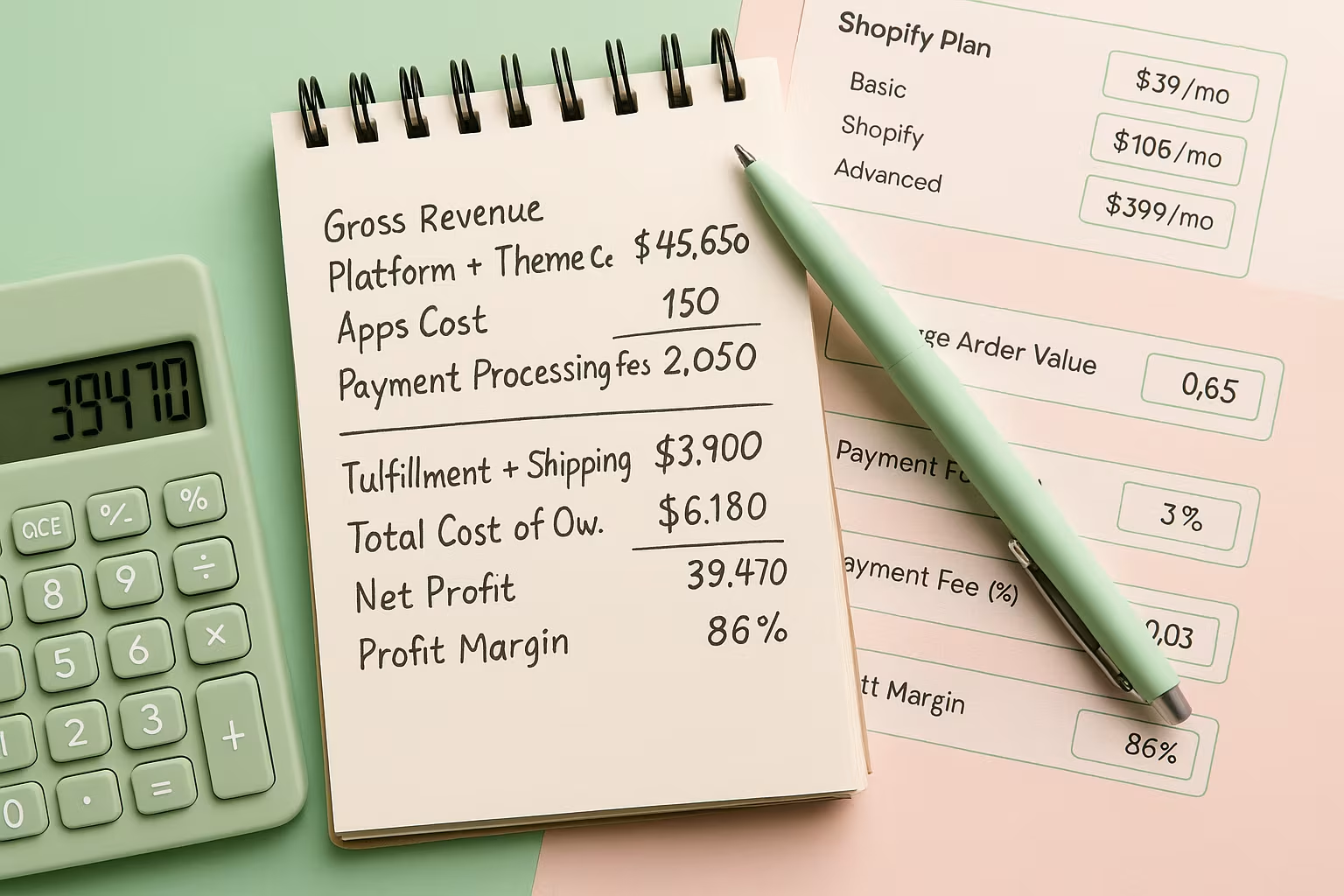
Shopify Fee Calculator: Instantly Reveal Your True Profit Per Order
.avif)
Not sure how much of each sale you actually keep after Shopify takes its cut? Our Shopify Fee Calculator clears the fog and instantly shows you the real costs behind every order.
Whether you’re setting prices, forecasting profits, or simply keeping an eye on shrinking margins, this tool breaks down fees with speed and accuracy.
Use it now to uncover hidden costs, fine-tune your pricing strategy, and make smarter business decisions that protect your bottom line.
Mastering the Shopify Fee Calculator: Every Component Explained with Real Profit Scenarios
Here's a detailed breakdown of each element in the Shopify Fee Calculator, complete with practical examples and real-world scenarios to help you maximize profitability, understand true costs, and make strategic pricing decisions for your Shopify store.
1. Selling Price Input
This field captures your product's list price before any discounts, establishing the baseline for all fee calculations and profit analysis.
Examples:
- Fitness Supplement Brand: $39.99 (premium positioning, competitive pricing)
- Coffee Products: $24.95 (mid-range market appeal)
- Skincare Line: $49.99 (luxury segment, higher margins)
Why It Matters: Your selling price determines revenue potential and directly impacts both percentage-based fees and overall profitability metrics.
2. Discount Percentage (Optional)
Apply promotional discounts to calculate fees and profits on the actual amount customers pay after reductions.
Examples:
- Launch Promotion: 15% off (attracting first-time buyers)
- Holiday Sale: 25% off (Black Friday, seasonal campaigns)
- Loyalty Reward: 10% off (repeat customer incentive)
Why It Matters: Discounts reduce your effective selling price, which lowers card fees but also impacts profit margins significantly.
3. Shipping Cost You Pay
Your per-order fulfillment expense that directly reduces profit, independent of Shopify's transaction fees.
Examples:
- US Domestic Standard: $4.50 (USPS Ground, supplement bottle)
- Express Shipping: $8.95 (2-3 day delivery for premium orders)
- Free Shipping Model: $0.00 (cost absorbed into product price)
Why It Matters: Shipping costs are pure expenses that reduce net profit without generating additional revenue or triggering extra fees.
4. Shopify Plan Selection
Your subscription tier determines credit card processing rates and platform fees, significantly impacting per-transaction costs.
Plan Examples:
- Basic Shopify: 2.9% + $0.30 (starting entrepreneurs, lower volume)
- Shopify: 2.7% + $0.30 (growing businesses, moderate sales)
- Advanced Shopify: 2.5% + $0.30 (established stores, high volume)
Why It Matters: Higher-tier plans offer lower transaction fees that can save thousands annually for high-volume sellers.
5. Payment Method Selection
Choose between Shopify Payments or third-party gateways, each with distinct fee structures affecting your bottom line.
Options:
- Shopify Payments: Uses plan-based rates only, no additional platform fees
- Third-Party Gateway: Adds extra Shopify platform fees (0.5%-2.0%) on top of gateway charges
Why It Matters: Third-party gateways incur double fees, gateway charges plus Shopify's platform fee, significantly reducing profitability.
6. Third-Party Gateway Fee Inputs (Conditional)
When using external payment processors, specify their percentage and fixed fees for accurate total cost calculations.
Common Gateway Examples:
- PayPal: 2.9% + $0.30 (standard rate)
- Stripe: 2.9% + $0.30 (industry standard)
- Authorize.net: 2.9% + $0.30 (traditional processor)
Why It Matters: External gateways trigger Shopify's extra platform fee, making them substantially more expensive than Shopify Payments.
7. Card Fees Display
Shows the exact credit card processing cost based on your plan and payment method, the primary per-transaction expense.
Performance Examples:
- Basic Plan Transaction: $39.99 sale = $1.46 in card fees (2.9% + $0.30)
- Shopify Plan Transaction: $39.99 sale = $1.38 in card fees (2.7% + $0.30)
- Advanced Plan Transaction: $39.99 sale = $1.30 in card fees (2.5% + $0.30)
Why It Matters: Card fees are unavoidable costs that scale with transaction value, directly impacting margin calculations.
8. Platform Fee Display (Third-Party Only)
Additional Shopify charge when not using Shopify Payments, visible only for third-party gateway selections.
Fee Structure:
- Basic Plan: 2.0% platform fee on transaction amount
- Shopify Plan: 1.0% platform fee on transaction amount
- Advanced Plan: 0.5% platform fee on transaction amount
Example: $39.99 sale on Basic plan = $0.80 extra platform fee beyond gateway charges
Why It Matters: This hidden cost makes third-party gateways significantly less profitable than Shopify Payments.
9. Total Fees Display
A comprehensive sum of all transaction costs, including card fees, platform fees, and shipping expenses, that you incur.
Scenario Examples:
- Shopify Payments (Basic): $1.46 card fees + $4.50 shipping = $5.96 total
- Third-Party Gateway (Basic): $1.46 gateway + $0.80 platform + $4.50 shipping = $6.76 total
- Advanced Plan Advantage: $1.30 card fees + $4.50 shipping = $5.80 total (saves $0.16 per order vs Basic)
Why It Matters: Understanding true total costs reveals the real expense of each sale for accurate profitability assessment.
10. Profit Per Order Display
Your net earnings are after deducting all fees and shipping costs from the discounted selling price.
Profit Examples:
Strong Margins:
- Supplement: $39.99 sale - $5.96 fees = $34.03 profit (85.1% margin)
Moderate Margins:
- Coffee Product: $24.95 sale - $5.22 fees (Basic, $4.50 shipping) = $19.73 profit (79.1% margin)
Discounted Sale:
- Original: $39.99 with 25% discount = $29.99 effective price
- Fees: $1.17 card + $4.50 shipping = $5.67 total
- Profit: $24.32 (81.1% margin maintained)
Why It Matters: Profit per order determines business sustainability and guides pricing strategy for long-term growth.
11. Margin Percentage Display
Profit as a percentage of your effective selling price (after discounts), revealing true profitability per transaction.
Margin Categories:
- Excellent (70%+): Premium supplements, high-value skincare (strong positioning)
- Good (50-70%): Coffee products, mid-range items (healthy operations)
- Moderate (30-50%): Competitive categories, promotional sales (acceptable for volume)
- Poor (Below 30%): Unsustainable pricing requiring immediate adjustment
Why It Matters: Margin percentage reveals whether your pricing strategy supports profitable operations and business scalability.
12. Breakeven Price Guidance
The minimum selling price required to cover all fees and shipping costs at zero profit is critical for promotional planning.
Strategic Applications:
- Promotional Floor: Product with $5.96 in costs = $6.06 breakeven on Basic plan (never discount below)
- Bundling Strategy: Understand minimum pricing for multi-product offers
- Competitive Analysis: Determine the lowest viable price point while maintaining operations
Why It Matters: Knowing your breakeven prevents unprofitable discounting and ensures every sale contributes positively to operations.
Complete Profit Analysis Example
Scenario: Premium Supplement Brand on Shopify Plan
Input Values:
- Selling Price: $49.99
- Discount: 20% (limited promotion)
- Shipping Cost: $5.00
- Plan: Shopify (2.7% + $0.30)
- Payment Method: Shopify Payments
Results:
- Effective Price: $39.99 (after 20% discount)
- Card Fees: $1.38 (2.7% of $39.99 + $0.30)
- Platform Fee: $0.00 (Shopify Payments)
- Total Fees: $6.38
- Profit Per Order: $33.61
- Margin: 84.1%
- Breakeven Price: $6.42
Analysis: Exceptional profitability, even with a 20% discount, demonstrates strong pricing power and efficient cost structure. The high margin provides flexibility for aggressive marketing spend while maintaining healthy unit economics.
Strategic Recommendations:
- Test 25% discount threshold to maximize customer acquisition while preserving 75%+ margins
- Consider upgrading to the Advanced plan if processing 200+ monthly orders (saves $0.08 per transaction)
- Maintain Shopify Payments to avoid 1% platform fee ($0.40 per order)
- Bundle products to increase average order value and improve per-order economics
Understanding these calculator components empowers Shopify merchants to make data-driven pricing decisions, optimize fee structures, and maximize profitability while maintaining competitive positioning in their market segment.
Real Shopify Fee Comparison: See How It Stacks Up Against Competitors
One of the most common questions merchants have is simple: “Are Shopify’s fees actually worth it compared to other platforms?” It’s a fair concern, after all, transaction costs and monthly subscriptions can quietly eat into your profits if you don’t run the numbers.
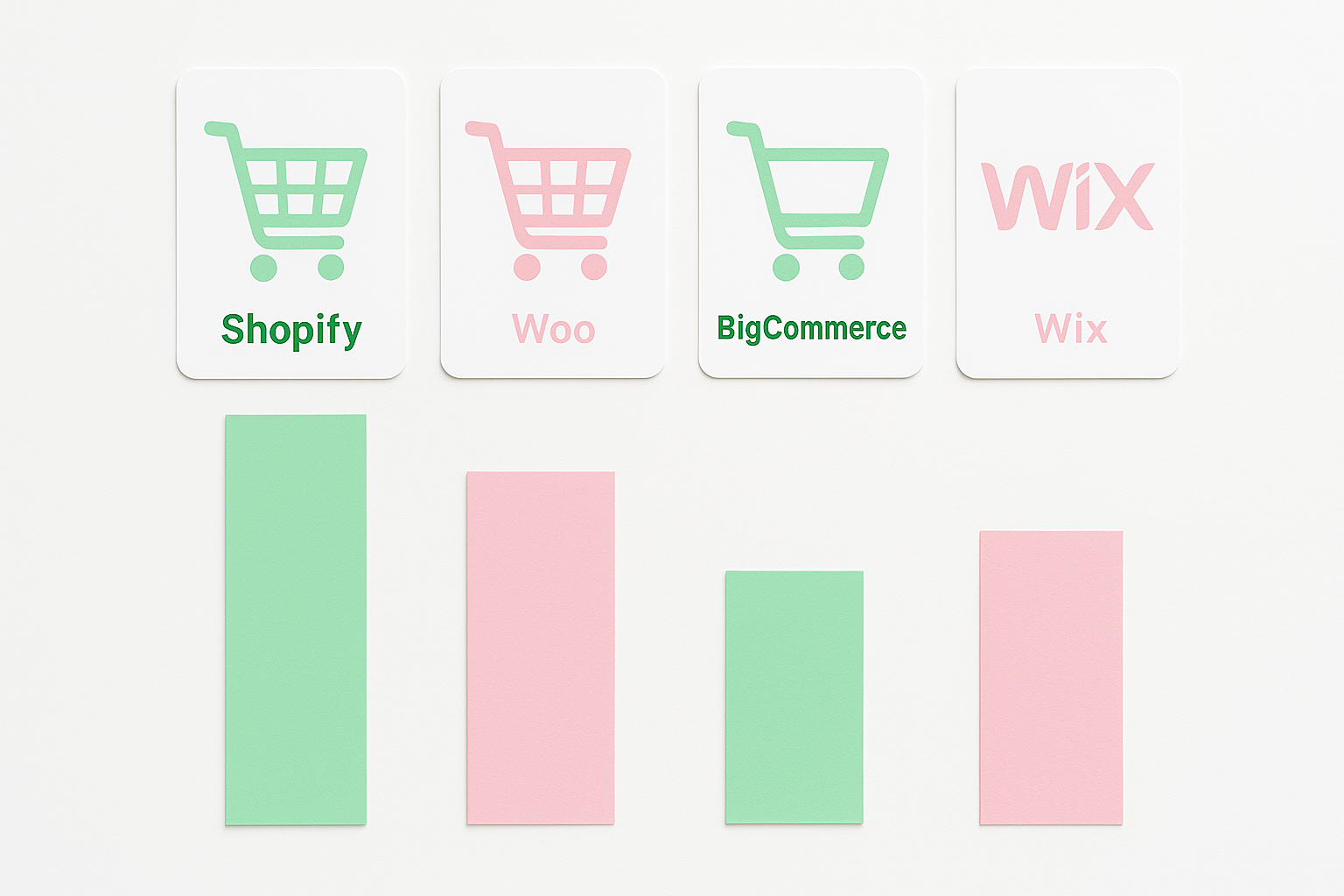
Below, we lay out a clear, side-by-side look at Shopify fees versus three popular alternatives: WooCommerce, BigCommerce, and Wix.
When you evaluate fee structures, there are two elements you must always combine:
- Subscription costs (the flat monthly fee you pay to run the store)
- Transaction fees (the percentage and fixed charge on each sale)
Ignoring either gives an incomplete picture. What really matters is the total cost of ownership (TCO), the amount you’ll actually spend when subscription and per-order fees add up.
Most founders underestimate how these two stack together over time. That’s exactly why we built our Subscription Cost Calculator - a tool that lets you model your true per-subscriber costs and margins before you lock in pricing.
Why Shopify Looks Different
Shopify’s pricing tiers (Basic, Shopify, and Advanced) each reduce card transaction rates slightly as you move up. At higher volumes, that small percentage difference translates into thousands saved annually.
However, if you don’t use Shopify Payments, an extra “platform fee” kicks in (0.5%–2.0% depending on your plan). This makes third-party gateways like PayPal more expensive unless you really need them.
Comparison at a Glance
Here’s a simplified look at fees across the major players (assuming an average $100 order value, one order per day, 30 orders per month):
| Platform | Monthly Plan* | Transaction Fee | Illustrative Cost (Plan + Tx Fees) | Notes / Caveats |
|---|---|---|---|---|
| Shopify (Basic) | $39 (monthly billing) | 2.9% + $0.30 (using Shopify Payments) | ~$135 for 30 × $100 orders | If using a non-Shopify gateway, add Shopify’s extra 2% platform fee |
| WooCommerce | $0 plugin | Processor fee (e.g., 2.9% + $0.30) | ~$96 (plus hosting ~$20–40) | Requires separate hosting, security, and plugin costs |
| BigCommerce | ~$29–$299 (depending on plan) | Processor fee only | Depends on plan & volume | BigCommerce doesn’t charge transaction fees itself on many plans |
| Wix (Business plan) | ~$34–$36 (varies) | ~2.9% + $0.30 | Depends on volume | Some lower tiers may have caps or extra costs; annual discounts apply |
What This Means for You
- At low volumes, WooCommerce might look cheapest, but once you add hosting, security, and extension costs, it levels out with Shopify and BigCommerce.
- At mid to high volumes, Shopify’s reduced rates on higher-tier plans help recover subscription costs and can save significant money, especially if you stick with Shopify Payments.
- Wix is attractive for simplicity, but it lacks the depth and scalability that Shopify offers once your business grows.
Shopify may not always be the cheapest on paper, but for merchants aiming to grow, its transparent scaling and ecosystem often make the fees worthwhile.
Now that you can see your true margins with our calculator, make the next step effortless - integrate Shopify with Supliful. You’ll sync products in one click, automate fulfillment, and keep every order profitable without touching inventory.
Scale Confidently With Clear Profit And Fee Visibility
Understanding your true profit per order is no longer a guessing game. With the Shopify Fee Calculator, you can see every cost clearly: subscription fees, transaction charges, platform add-ons, and shipping, so nothing eats into your margins unnoticed.
By testing different scenarios, comparing gateways, and tracking breakeven points, you gain the insight needed to fine-tune pricing, run promotions smartly, and choose the right plan. Use this clarity to protect your bottom line, avoid hidden losses, and grow your store with confidence, knowing every sale is built on sustainable profit.
Frequently Asked Questions
Find answers to all of your unanswered questions
Want to learn more?
Explore our Help Center for detailed answers, expert advice, and step-by-step guides.
Related blogs

Dynamic Pricing Calculator: Optimize Margins and Sell Smarter With Every Click
.avif)
TikTok Shop Profit Calculator: See True Margins, Break-Even, and ROI in Seconds