Price Elasticity Of Demand Calculator: Predict Revenue Impact in Seconds

About Supliful
Understanding how price changes affect customer demand is critical for any e-commerce business.
The price elasticity of demand calculator helps you make data-driven pricing decisions by showing exactly how revenue, profit margins, and order volume respond to price adjustments.
Instead of guessing whether customers will tolerate a price increase or respond to discounts, you can test scenarios and see projected outcomes before making changes.
Perfect for anyone selling products online who wants to optimize pricing strategy without leaving money on the table.
How Price Elasticity Impacts Your E-commerce Revenue
Price elasticity measures customer sensitivity to price changes, and understanding it transforms how you price your products. When you know whether customers are price-sensitive or value-focused, you can make confident decisions about discounts, promotions, and premium positioning.
The concept is straightforward:
- Elastic demand (coefficient > 1): Customers are price-sensitive; small price changes cause large shifts in order volume
- Inelastic demand (coefficient < 1): Customers are less price-sensitive; demand stays relatively stable despite price adjustments
- Unit elastic (coefficient = 1): Price and demand changes offset each other perfectly
Why this matters for your online store
Most sellers price products based on gut feeling or competitor matching without understanding their actual demand curve.
They see a competitor selling protein powder for $29.99 and immediately match it, potentially leaving thousands in uncaptured revenue on the table. Or they discount aggressively when customers would have purchased at full price.
Understanding elasticity helps you avoid these costly mistakes. For example, if you're selling private label supplements with unique formulations, you might discover low elasticity, meaning you can raise prices 10-15% with minimal volume loss. That's pure margin expansion.
Conversely, if you're in a commodity market like basic coffee blends, high elasticity means competitive pricing is essential for maintaining market share.
Strategic applications of elasticity data include:
- Promotional planning: Know exactly how much to discount during Black Friday without over-sacrificing margin
- New product launches: Price skincare products or pet care items at optimal levels from day one
- Brand positioning: Determine if you should compete on price or invest in premium branding
- Inventory management: Make smarter decisions about clearance pricing and stock levels
The calculator removes guesswork by showing you real revenue projections based on different price points. This is especially valuable when managing multiple products across platforms like Shopify and TikTok Shop, where pricing strategies might differ by channel.
Using the Calculator to Test Pricing Scenarios
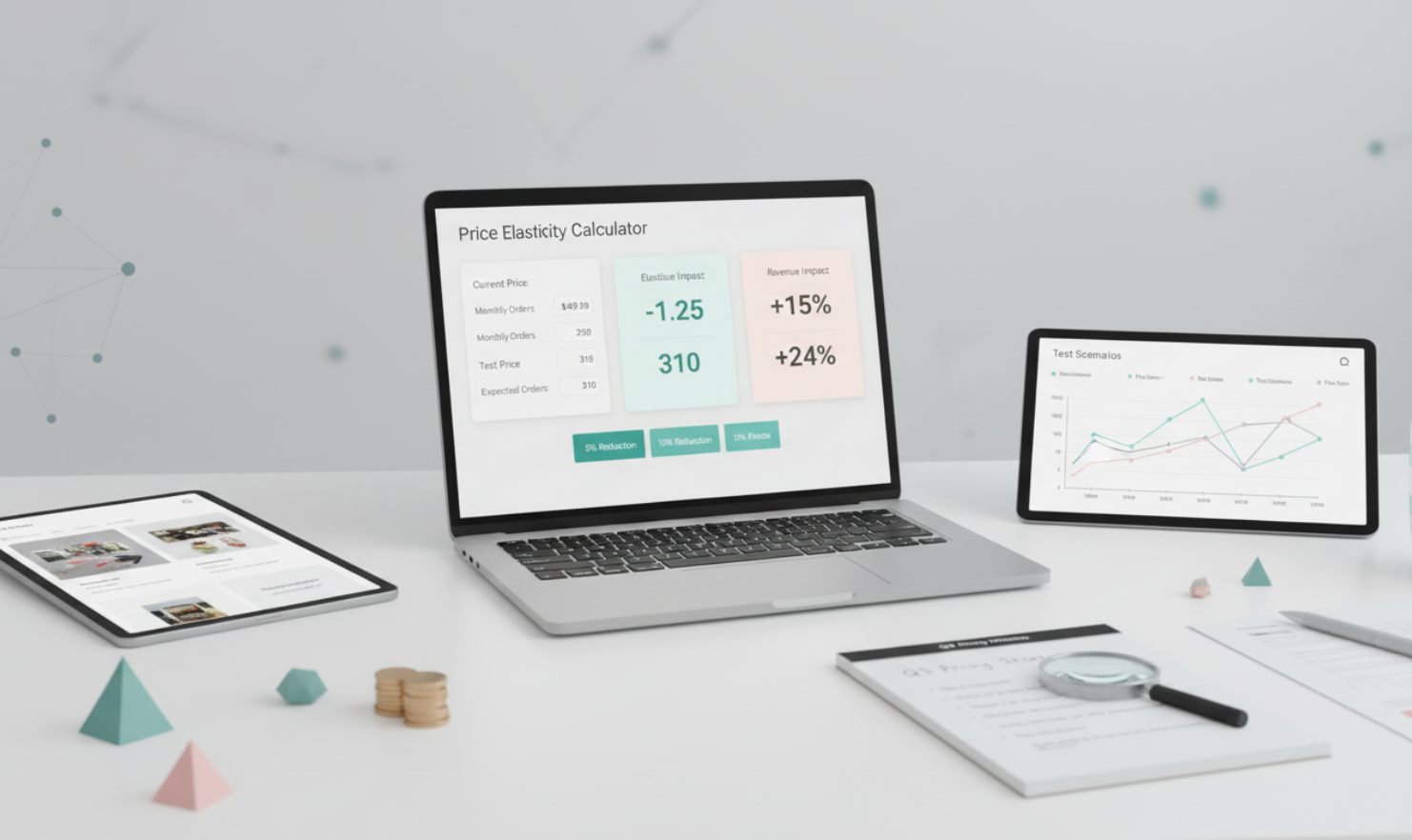
Getting actionable insights from the Price Elasticity of Demand Calculator requires the right approach to testing and data interpretation. Here's how to extract maximum value from your analysis.
Start with accurate baseline data. You need four key inputs:
- Current price per unit (your actual selling price after all discounts)
- Current monthly orders (use a 30-day average for consistency)
- Test price (the new price point you're considering)
- Expected monthly orders at new price (estimate based on market research or small tests)
If you don't have test data yet, run small experiments on one sales channel before making store-wide changes. Launch a TikTok Shop test at a different price point or use Shopify's built-in A/B testing to gather real customer response data.
The calculator reveals three critical metrics:
- Elasticity coefficient: The mathematical measure of price sensitivity
- Revenue impact: Projected monthly revenue at your new price point
- Volume changes: Expected increase or decrease in order quantity
Smart testing strategies involve running multiple scenarios, not just one. Test incremental changes:
- Run 5%, 10%, and 15% price reductions to find your optimal discount depth
- Test gradual increases ($2, $5, $10 increments) to identify your pricing ceiling
- Compare your numbers against competitors to evaluate if their pricing makes sense for your cost structure
For private label products, start by testing prices 25-40% above your landed cost. This establishes your baseline elasticity and reveals how much pricing power you actually have.
If you're in competitive categories like fitness supplements or productivity boosters, test more aggressively since customers actively comparison shop.
Remember that elasticity changes over time. Seasonal demand, competitor actions, and your growing brand reputation all affect customer price sensitivity. Retest quarterly, especially before major promotional periods or when launching new products. What worked last quarter might not be optimal today.
Common testing mistakes to avoid:
- Testing only one price point instead of multiple scenarios
- Ignoring seasonal variations in customer behavior
- Failing to account for fulfillment cost changes at different volume levels
- Not considering the impact on customer lifetime value
The goal isn't just to find a price that works today but to understand your pricing flexibility for strategic decision-making throughout the year.
Three Pricing Strategies Based on Your Results
Your elasticity results should directly inform your pricing strategy. Different elasticity profiles require completely different approaches to maximize profitability.
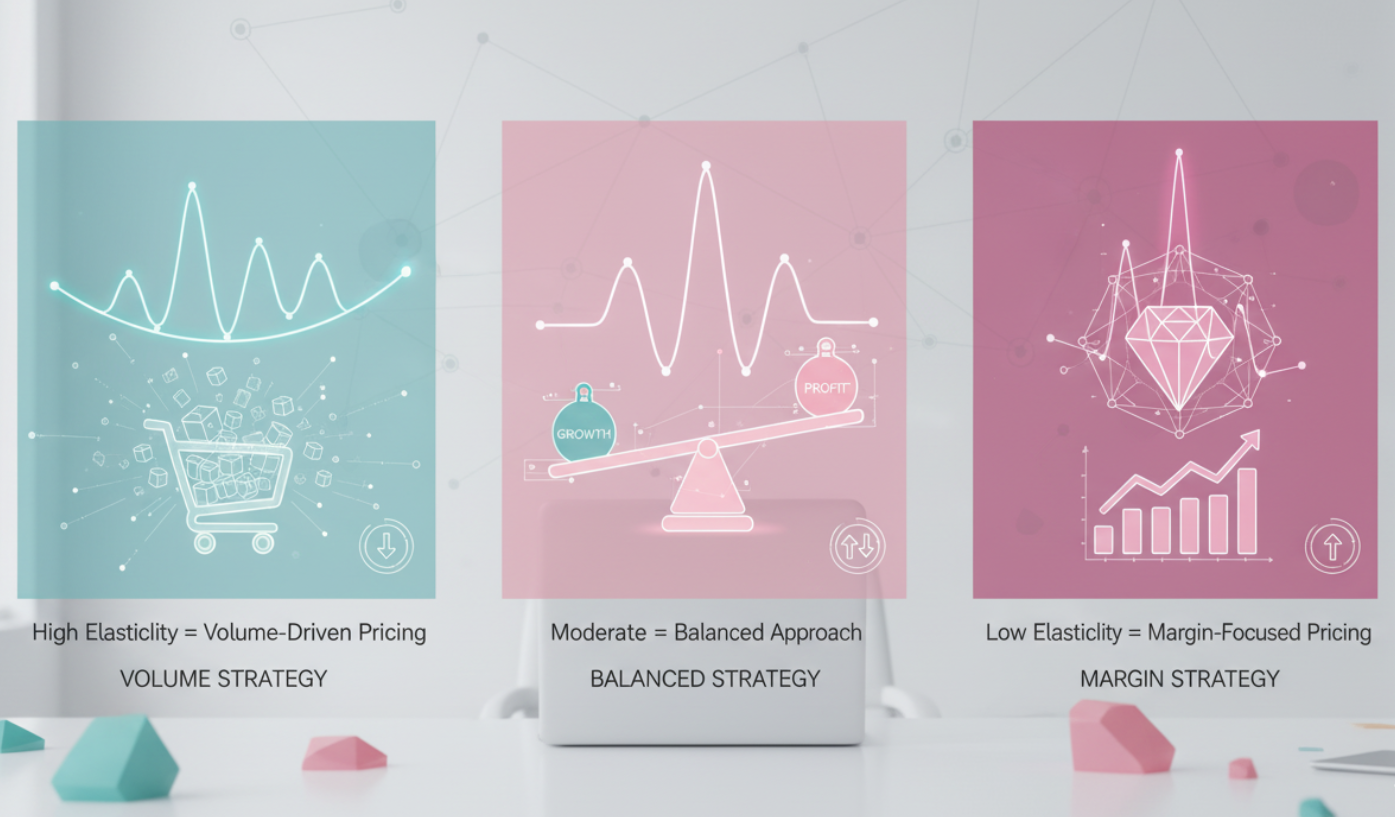
Strategy 1: High Elasticity = Volume-Driven Pricing
If your coefficient is above 1.5, you're competing in a price-sensitive market. This is common for:
- Standard supplements without unique ingredients or formulations
- Generic coffee products compete primarily on price
- Basic skincare items where customers easily find alternatives
Your pricing playbook:
Focus on competitive pricing to capture maximum market share. Even small price increases will cost you significant volume, so your profit comes from scale, not margin. Consider subscription offerings at discounted rates to lock in recurring revenue.
Use product bundles to increase average order value while maintaining competitive unit pricing.
Invest marketing dollars in broad audience targeting since price is your main competitive advantage. Focus on operational efficiency and fulfillment optimization to maintain profitability at lower margins.
Strategy 2: Low Elasticity = Margin-Focused Pricing
If your coefficient is below 0.5, you have significant pricing power. This typically indicates:
- Specialized formulations like nootropics or longevity products
- Strong brand loyalty built through consistent quality and marketing
- Unique products solving specific problems competitors don't address effectively
Your pricing playbook:
Raise prices incrementally every quarter until you see elasticity increase. Test 5-10% increases and monitor customer response carefully. Your customers value quality, convenience, or brand reputation over price, so capture that value.
Invest in premium branding and professional label design to justify higher pricing. Discount sparingly, only for customer acquisition campaigns, never to move inventory. Focus on building customer lifetime value since your buyers are loyal and less likely to churn over price.
Strategy 3: Moderate Elasticity = Balanced Approach
If your coefficient falls between 0.5 and 1.5, both price and value matter equally. Common for:
- Established product lines with moderate brand recognition
- Mid-tier hair care products or digestive health supplements
- Growing brands that haven't reached premium status yet
Your pricing playbook:
Test price increases carefully while monitoring conversion rates closely. Use selective promotions during peak seasons to drive volume without training customers to wait for discounts.
Build brand equity through content marketing and influencer partnerships to gradually reduce price sensitivity.
Balance margin optimization with strategic growth investments. This middle ground is actually the most strategic position because you can pull levers in both directions based on business goals.
Avoiding Critical Pricing Mistakes
Even with elasticity data, sellers make costly pricing errors that hurt profitability. Here's how to avoid the most common traps.
Mistake 1: Applying uniform pricing across all products
Your sleep supplements likely have different elasticity than your pre-workout formulas. Price them identically, and you'll sacrifice margin where you have pricing power or lose volume where competitive pricing matters.
Solution: Test your top 5-10 SKUs individually. Use products with low elasticity for profit, products with high elasticity for customer acquisition. This portfolio approach maximizes overall business profitability.
Mistake 2: Panic-matching competitor price cuts
When competitors drop prices by 20%, many sellers immediately match without analyzing their own elasticity. If your demand is inelastic, you'll sacrifice a 20% margin for minimal volume gain.
Solution: Run competitor prices through your calculator first. If your elasticity suggests holding firm preserves profit, compete on value and customer experience instead of price. Invest in branded customer support or faster fulfillment rather than margin erosion.
Mistake 3: Ignoring total cost economics
Lower prices drive higher volume, but do your fulfillment costs scale favorably? More orders don't always mean more profit, especially with volume-based fee structures.
Solution: Calculate true per-order costs, including shipping, platform fees, payment processing, and handling, before finalizing price changes. Use a profitability calculator alongside elasticity data for the complete financial picture.
Mistake 4: Setting prices once and forgetting them
Market conditions, seasonality, and competitive landscapes shift constantly. Elasticity from six months ago might not reflect today's reality.
Solution: Retest elasticity quarterly and before major promotional periods. Track your average profit margins and conversion rates to spot when pricing needs adjustment.
The difference between understanding elasticity and acting on it strategically determines whether pricing changes grow your business or drain profitability.
Test thoroughly, implement carefully, and remember that optimal pricing evolves as your brand matures and market conditions change.
Turn Elasticity Insights Into Immediate Revenue Wins
Understanding how customers respond to price changes gives you a major strategic edge. Test multiple scenarios, compare outcomes, and adjust your pricing with confidence.
Whether you're planning promotions, exploring premium positioning, or refining product margins, these insights help you act quickly and profitably. When used consistently, elasticity analysis becomes a powerful tool for unlocking sustainable revenue growth.
FAQ


Related blogs
.avif)
Contribution Margin Calculator: Measure What Each Sale Contributes to Profit
SKU Rationalization Score Tool: Cut Waste, Improve Margins, and Scale the Right Products