Brand Value Calculator: Find Out What Your Brand Is Actually Worth
.avif)
You built the store. You ran the ads. You figured out the margins, tested the products, and kept the machine running.
But here's the question most operators never stop to ask: what is all of this actually worth?
Not tomorrow's revenue. Not next month's profit. The whole thing: as a sellable, transferable business asset.
Use the brand value calculator above to get your estimate in under two minutes.
Six Metrics That Determine What Your Brand Is Worth to a Buyer
Most e-commerce sellers think about valuation backwards.
They assume the number is something that gets revealed at the end; when they're ready to sell, when a broker runs the math, when an acquirer makes an offer. By then, it's usually too late to change anything.
The operators who exit well think about valuation from day one. They build with the end in mind, making decisions about margins, retention, and brand equity the same way a future buyer would evaluate them.
Here's what actually drives brand value in a DTC or private label business:
- Annual net profit: The foundation of every valuation model. Buyers pay a multiple of what the business earns, not what it sells.
- Profit margin: High-margin products signal operational efficiency and pricing power. Wellness and supplement brands that maintain 25–40% net margins consistently attract stronger multiples.
- Revenue growth trajectory: A brand growing 40% year-over-year tells a very different story than one that's plateaued. Growth signals future upside for the buyer.
- Repeat customer rate: This is the metric that separates a brand from a store. A 35%+ repeat purchase rate tells buyers there is real loyalty, not just ad-driven traffic.
- Owned audience: Email lists, SMS subscribers, and engaged social followings are assets that transfer with the sale. A brand with 50,000 email subscribers is worth more than an identical brand with none.
- Valuation scenario: The category, business model, and market conditions all influence what multiple a buyer is willing to pay.
Get any of these wrong, or ignore them entirely, and you leave real money on the table. The calculator above pulls all six variables together to give you a working range based on how DTC brands are actually valued in the current market.
How the Calculator Works: The Math Behind Your Numbers
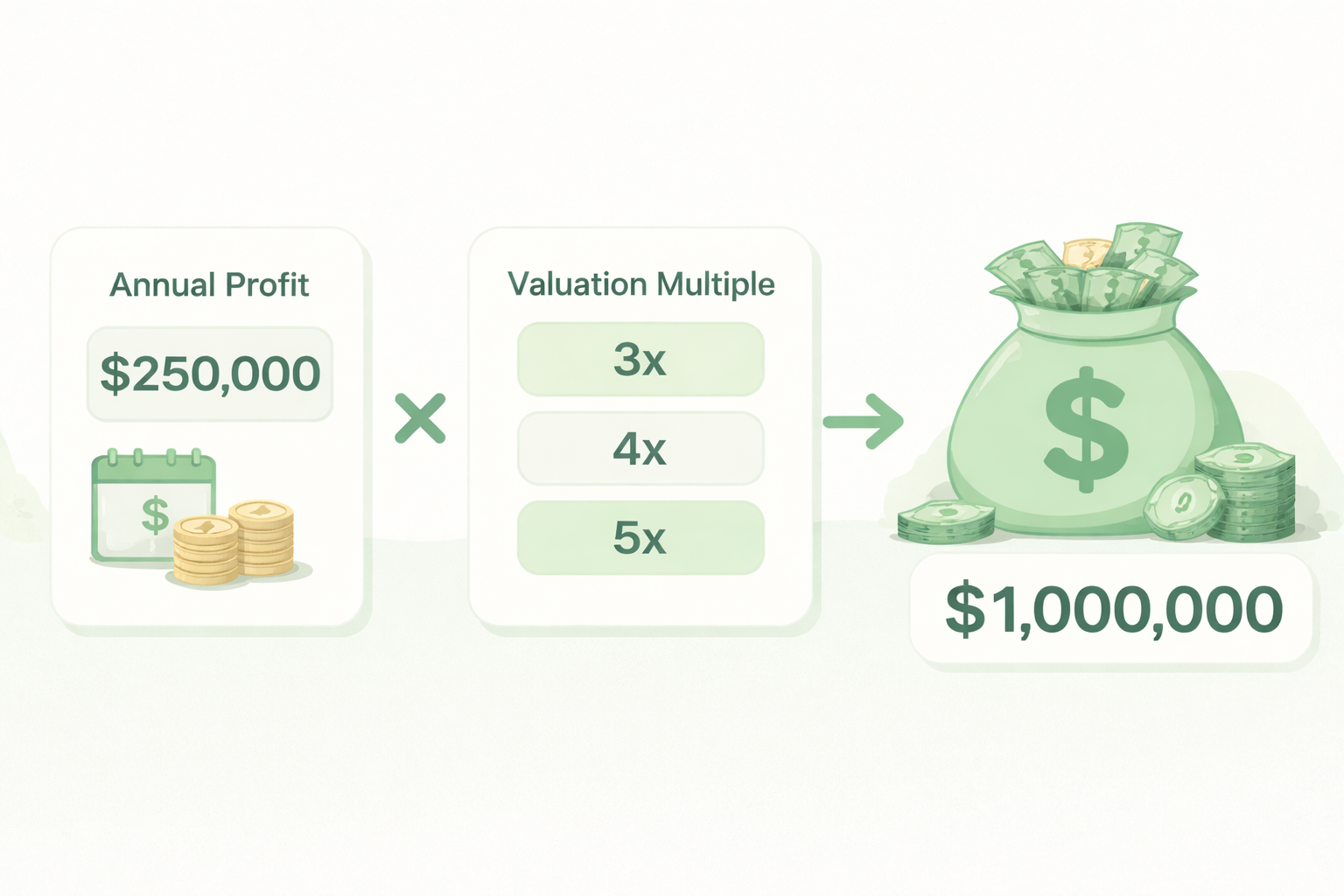
The calculator uses a straightforward but accurate methodology: Annual Profit x Valuation Multiple = Brand Value.
Annual profit is calculated from your monthly revenue and net margin, annualized over 12 months. The multiple is then applied in a range, Low, Mid, and High, based on the scenario you select, and adjusted further by the optional inputs you provide.
The four valuation scenarios:
- Conservative (2-3x): Early-stage brands, inconsistent revenue, thin margins, or minimal brand identity. Common in general-product dropshipping stores with no real differentiation.
- Typical (3-5x): Steady DTC brands with consistent revenue, reasonable margins, and a growing customer base. The range most established private label brands fall into.
- Aggressive (5-8x): Brands with strong growth, loyal customers, high margins, and clear competitive positioning. Usually, brands have moved well beyond product-market fit.
- Premium (8-12x): Dominant players with exceptional metrics across the board; repeat rates above 50%, growing audiences, and margins that justify a strategic acquisition price.
How the optional fields adjust your multiple:
The three optional inputs, growth rate, repeat customer rate, and audience size, apply a bonus or penalty directly to your base multiple:
- A brand growing over 100% YoY can add up to +0.8x to the multiplier
- Repeat customer rates of 60%+ add up to +0.6x
- An audience over 100,000 adds +0.5x
- Negative growth reduces the multiple by up to -0.5x
These adjustments reflect how real buyers think. When you track your ecommerce ROI alongside brand metrics, the picture becomes a lot clearer, and the calculator gives you a fast read on where you stand.
The Difference Between a Store and a Sellable Brand Asset
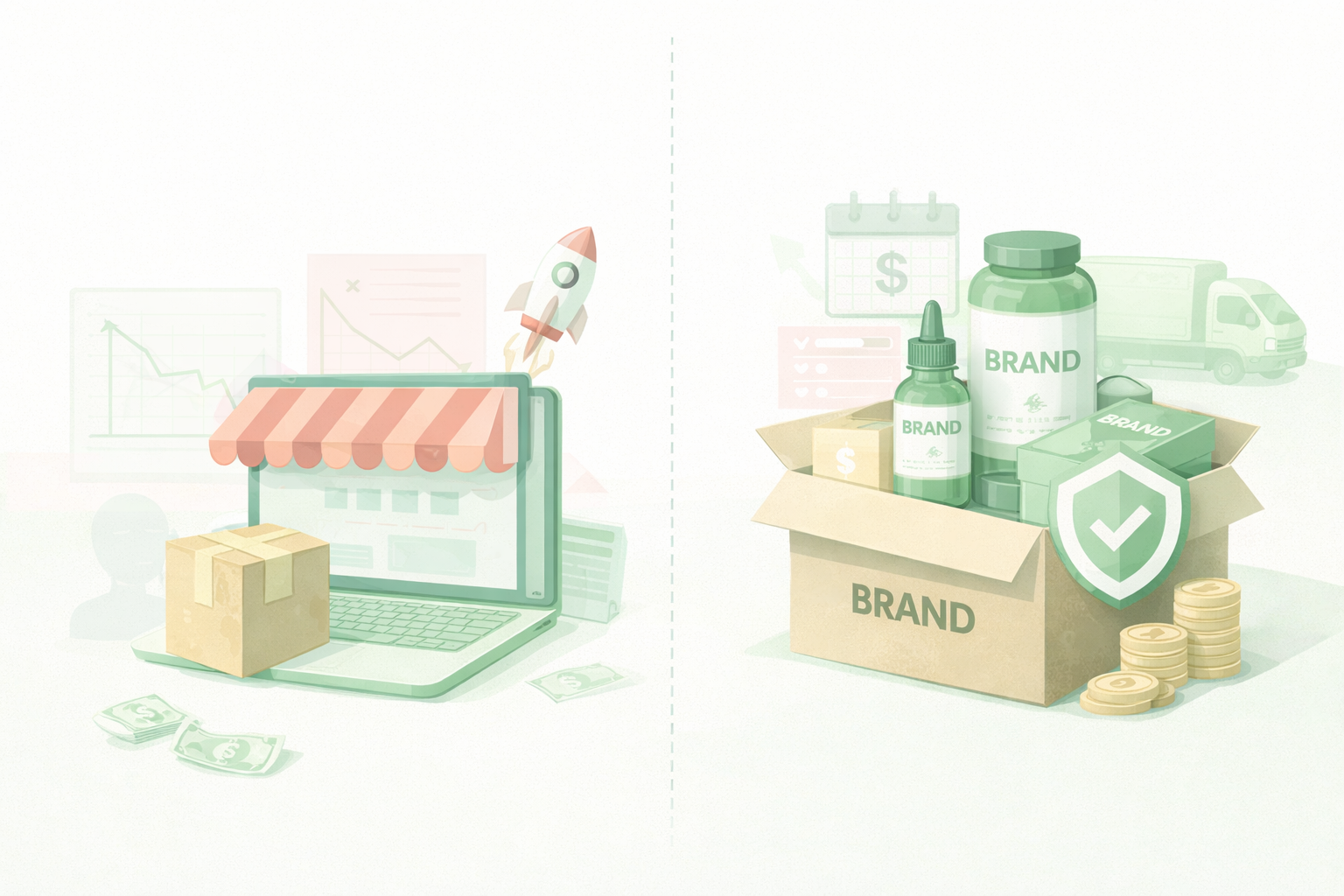
This distinction changes how you build everything, so it's worth being direct about it.
A dropshipping store running on a single supplier, generic products, and zero repeat buyers is worth roughly zero when the ads stop. There is no asset there, only the next campaign.
A brand built on consumable products, a loyal customer base, and owned distribution is something else entirely. Buyers pay multiples for predictable, durable profit, and that is what a real brand produces.
This is why private label brands built on consumables like supplements, coffee, and skincare attract serious acquisition interest.
Customers reorder. Margins hold. Customer lifetime value compounds over time in a way that generic merchandise never will.
What moves a brand from "store" to "sellable asset":
| What It Is | Why Buyers Care |
|---|---|
| Subscription or reorder component | Consumables create repeat behavior without needing to re-acquire the customer. |
| Branded packaging and identity | A distinct brand exists independently of the founder, increasing long-term value. |
| Diversified traffic | Email, SEO, and organic channels reduce reliance on paid ads and improve stability. |
| Clean, documented financials | Verified revenue allows buyers to assess risk and confidently value the business. |
| Operational independence | Systems run without daily founder involvement, making the business scalable and transferable. |
When you start a private label business with exit value in mind, each of these becomes a deliberate building block, not an afterthought you scramble to fix six months before listing.
How to Use Your Estimate to Build a Better Brand

The number this calculator gives you is not just a valuation; it's a diagnostic. Run it now, then again in six months after making targeted improvements, and you'll see exactly how each variable moves the needle.
Read your result against these four scenarios; each one points to a specific action you can take right now.
Your valuation is lower than expected
Look at which input is dragging the number down. Margin? Growth? Retention? A 5-point margin improvement or a 10% lift in repeat customer rate can shift your multiple significantly. That's your bottleneck; fix it first.
You're stuck on the Conservative scenario
Ask honestly whether your products give a customer a reason to come back. Dropshipping vs. private label is ultimately a question of whether you're building an asset or running arbitrage. Switching to a branded consumable line is often the single most impactful change an operator can make.
Your audience size is zero
Start building it today. An email list of 10,000 engaged subscribers is worth more to a buyer than 100,000 social followers you don't own. Buyers pay for owned distribution because it survives the acquisition.
Your growth rate is flat or negative
This needs to be addressed before any exit conversation. Declining revenue compresses multiples sharply and makes buyers walk. The right ecommerce platform and product mix can reverse this faster than most operators expect.
The brands that exit well are not always the biggest. They are the most deliberately built. Every metric in this calculator is something you can actively improve, and the earlier you start, the more the final number reflects the work you actually put in.
To see how successful brands have scaled from dropshipping into real sellable assets, the path consistently runs through consumable products, strong unit economics, and an end-to-end fulfillment partner that keeps you focused on brand and growth, not logistics.
Use Your Valuation As A Strategic Growth Roadmap
Your valuation isn’t just a number; it’s feedback. It shows you exactly where your brand stands today and where it needs to improve tomorrow. Margin, growth, retention, audience, each lever moves your multiple in measurable ways.
Run the calculator now. Identify your weakest metric. Fix that first. Then run it again in six months.
Brands that exit well aren’t built by accident. They’re engineered with intention. When you treat your valuation as a roadmap instead of a mystery, you stop chasing revenue and start building a real, sellable asset.
.avif)
.avif)
.avif)
.avif)