How To Do Market Research For Beauty And Skincare Products: Important Tools to Utilize
.avif)
The beauty and skincare industry is one of the most competitive in e-commerce. Global brands, indie startups, and influencer-backed labels all fight for attention in a market shaped by fast-moving trends, viral videos, and shifting consumer expectations.
Relying on gut instinct isn’t enough. Market research for beauty and skincare products must use data, insights, and customer signals to reveal winning products, lasting trends, and strategies for growth.
This guide breaks down the tools for doing market research for beauty and skincare products. It also shows how to layer these insights with practical calculators and marketing strategies to move from research to profitable execution.
Five Essential Market Research Tools for Beauty and Skincare Brands
The most effective approach in this space is tool-driven research. Beauty buyers are influenced by visuals, social conversations, and perceived expertise, which means traditional surveys alone won’t cut it.
You need tools that capture the buzz, validate demand, analyze competitors, and reveal customer behavior.
Here are the five categories of tools every beauty entrepreneur should be using:
- Social Listening Tools → Spot where trends start
- Search & Trend Analysis → Quantify consumer interest
- Competitor Analysis Platforms → Understand positioning
- Customer Feedback Tools → Gather raw consumer insights
- Industry Reports & Consumer Data → Confirm long-term demand
Here’s a closer look at each tool category and the role it plays in effective beauty and skincare research.
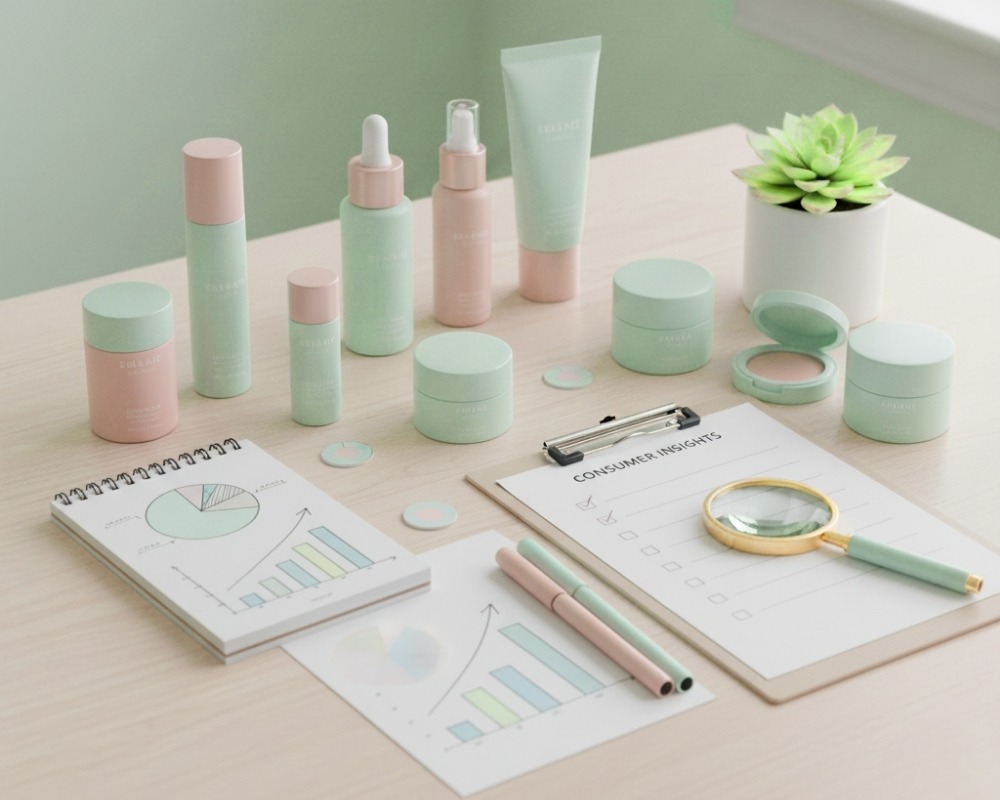
Social Listening Tools: Where Beauty Trends Begin
Most beauty trends start online, often on TikTok, Instagram, or YouTube. A single influencer video can turn an obscure product into a global bestseller. That makes social listening the frontline of research.
Best tools for beauty trend spotting:
- TikTok Creative Center: Explore trending beauty hashtags like #GlassSkin, #SPFObsessed, or #SkinCycling.
- BuzzSumo: See which beauty content is shared most frequently.
- Sprout Social / Brandwatch: Monitor brand mentions, sentiment, and emerging skincare conversations.
- Instagram Insights: For business accounts, track which types of content outperform.
Example: The “slugging” skincare trend, applying petroleum jelly overnight to lock in moisture, spread from Korean beauty routines to TikTok in 2022. Brands that listened early launched hydrating-focused products, while late adopters missed the wave.
Pair this insight with our print-on-demand niche research tool, which helps validate whether a micro-trend has enough market depth before committing to a product launch.
Search & Trend Analysis: Quantifying Interest
Social buzz is exciting, but search data shows commitment. If consumers are Googling “best vitamin C serum for sensitive skin” or “SPF moisturizer for oily skin,” that’s proof they’re actively shopping.
Best tools to validate demand:
- Google Trends: Compare the popularity of terms like “niacinamide serum” vs. “hyaluronic acid serum.”
- SEMrush or Ahrefs: Spot keyword demand and competition for beauty-related terms.
- Exploding Topics: Identify early-stage skincare or makeup trends.
- Amazon Keyword Tools (like Jungle Scout): Show real shopper searches within beauty marketplaces.
Example: Search data showed “SPF moisturizer” consistently rising year over year, proving consumers wanted multifunctional products. Smart brands positioned themselves around “all-in-one SPF skincare” before it became crowded.
Here’s where using an e-commerce profit calculator can help. After validating search demand for a product, you can run projections on whether price, cost, and margin assumptions support profitability before scaling.
Competitor Analysis: Learning From The Best
In beauty, competition is everywhere. From indie DTC brands to Sephora heavyweights, standing out means knowing what others are doing right, and where they’re falling short.
Best competitor analysis tools:
- SimilarWeb: See traffic sources for major beauty websites.
- Facebook/TikTok Ad Libraries: Review the ads competitors are running and test angles.
- Owletter or Mailcharts: Track beauty email marketing campaigns.
- Retail Platforms (Sephora, Ulta, Cult Beauty): Study bestseller sections and positioning.
Example: Competitors selling retinol creams often face complaints about irritation. By mining reviews, a new brand could position itself as “gentle retinol with hydration,” instantly carving out a clear gap.
For pricing research, try our bundle price calculator. Many skincare brands find success by bundling products (serum + cleanser + moisturizer). This tool helps you test different price points against costs to see which bundles can deliver both consumer value and healthy profit margins.
Customer Feedback Tools: Insights From Real Buyers
Beauty and skincare are personal, which means reviews, surveys, and direct conversations matter more here than in most industries. Customers openly share what they love and what frustrates them.
Best ways to capture feedback:
- Yotpo or Judge.me: Collect structured reviews on your store.
- Amazon Review Mining: Scan hundreds of competitor reviews to spot repeated themes.
- Typeform or SurveyMonkey: Create surveys to test product ideas or label designs.
- In-store Research: Visit Ulta, Sephora, or specialty boutiques to see what shoppers gravitate toward.
Example: Consumers often complain that certain sunscreens leave a white cast. Brands that researched this frustration successfully launched mineral sunscreens marketed as “no white cast,” solving a major pain point.
For a long-term strategy, combine this with a customer lifetime value calculator. If research shows buyers are willing to repurchase skincare monthly, CLV helps forecast how much you can afford to spend on acquisition while staying profitable.

Industry Reports & Consumer Data: Long-Term Validation
Trends come and go quickly, but reports and data platforms reveal lasting growth patterns. This helps you avoid chasing hype that fizzles.
Best data resources:
- NielsenIQ & Mintel: Track consumer preferences and sales growth across beauty categories.
- Euromonitor: Identify the fastest-growing regions for skincare and cosmetics.
- McKinsey Beauty Reports: High-level strategic insights on global shifts.
- Statista: Market size forecasts and category performance data.
Example: Reports show that “clean beauty” and “sustainable packaging” have grown consistently for five years, proving they’re not just fads. Brands that aligned early with eco-friendly skincare packaging now benefit from an entrenched consumer expectation.
Integrating Research With Marketing Execution
Market research doesn’t end once you know what to launch. It should shape your marketing playbook.
- SEO for Beauty Products: Keyword research should flow directly into your content plan. For instance, if “best moisturizer for acne-prone skin” is trending, it’s a natural blog angle.
- Influencer Partnerships: Research who actually drives sales in your niche, not just engagement. See our article on how influencers impact beauty sales for deeper tactics.
- Label Design Testing: If research reveals buyers care about clean formulations, reflect that on labels. Our content on designing labels for cosmetics offers practical design tips.
- Seasonal Promotions: Research spikes around holidays (Valentine’s Day, Black Friday) to plan campaigns. For example, promoting skincare bundles during Black Friday can maximize conversions, especially if bundle pricing is optimized with our calculator.
- Advertising Efficiency: Pair insights with a break-even ROAS calculator to see if your paid ad spend is generating sustainable returns.
By integrating calculators and marketing strategies, you turn research insights into real profitability levers.
Building Your Beauty & Skincare Research Stack
To summarize, here’s how a beauty brand can practically layer research tools and calculators:
- Spot trends with TikTok Creative Center → See if “skin cycling” or “SPF hybrids” are gaining momentum.
- Validate demand with Ahrefs or Google Trends → Confirm people are actively searching for these products.
- Study competitors with SimilarWeb + Ad Libraries → Understand positioning and ad angles.
- Mine reviews with Amazon feedback → Identify consumer pain points like irritation or scent.
- Check costs with a packaging cost calculator or a bundle price calculator → Ensure financial viability.
- Forecast profitability → Build sustainable business models.
- Align with reports from NielsenIQ or Euromonitor → Ensure it’s not just hype but an enduring shift.
Research That Creates Longevity and Beauty
Doing market research for beauty and skincare products is about more than spotting the next big trend. It’s about combining fast-moving consumer signals (like social and search) with hard data (from industry reports and calculators) to create a full picture.
Brands that guess or copy competitors risk short-lived launches. But those who research deeply, validate with the right tools, and plan around profitability calculators set themselves up to thrive, not just today, but in the long term.
In an industry where credibility, safety, and authenticity matter as much as aesthetic appeal, research isn’t optional. It’s the foundation that separates fleeting fads from beauty brands that last.
The information provided in this article is meant for general informational purposes only and should not be considered as professional or legal advice. We do not guarantee the completeness, accuracy, reliability, or suitability of the information in this article. We strongly recommend seeking professional guidance that suits your individual circumstances.
.avif)
.avif)
.avif)
.avif)